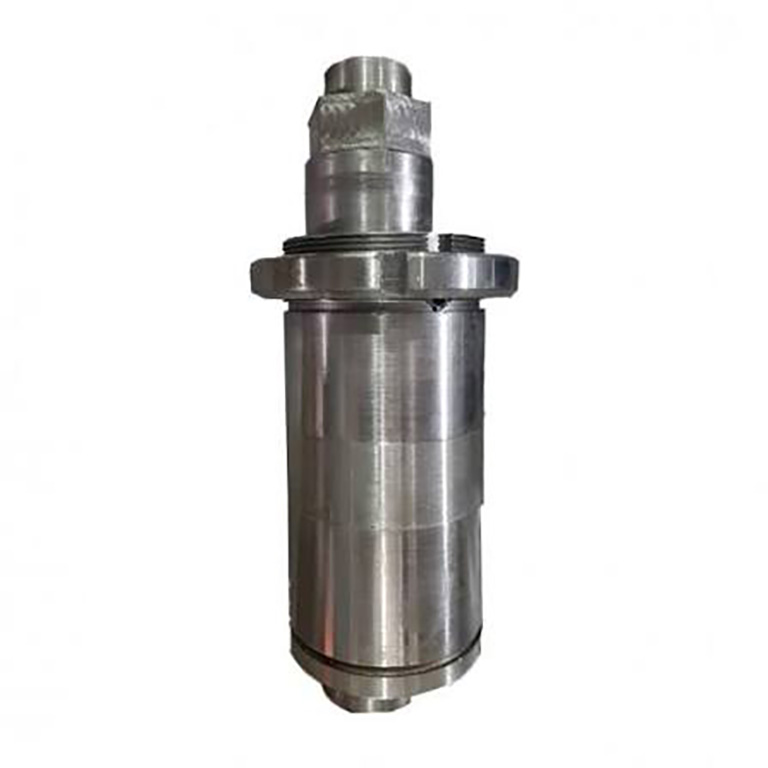

In industrial contexts, the term “shaft” generally refers to a rotating rod or axle that transmits power. In a pellet mill machine, the term typically refers to two main components:
1. Main Shaft (Drive Shaft)
- Function: This shaft receives rotational force from the main drive (typically an electric motor) and transmits it to the rollers. In ring die machines, this shaft is connected to a mechanism that drives the rotation of the rollers. In some designs, the main shaft is connected directly to the die, causing the die itself to rotate.
- Technical Importance: This shaft operates under extremely high pressure and torque. Therefore, it must be constructed from high-strength steel and specialized alloys. Any weakness or fracture in this shaft can lead to a complete machine shutdown and significant financial losses.
- Associated Components: The main shaft is usually connected to the motor via couplings or a gearbox and is supported on both ends by main bearings.
2. Internal Roller Shaft
- Function: In some roller assembly designs, there is an internal shaft upon which the roller assembly (including the roller shell) is mounted. This shaft is responsible for transmitting force from the machine’s drive mechanism to the roller assembly and for bearing the weight and forces exerted by the die.
- Technical Importance: This shaft must also possess sufficient strength to withstand both radial and axial forces. The integrity of this shaft is critical for maintaining the precise adjustment of the die-to-roller gap.