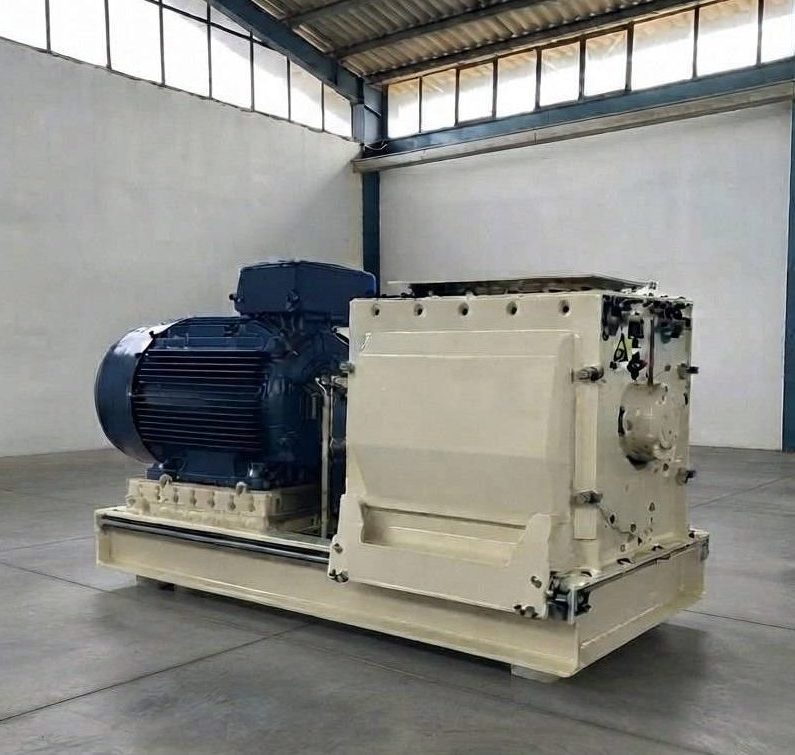

Grinding Precision, Consistent Quality
The Hammer Mill is essentially the frontline of a feed production factory. If the mill doesn’t function correctly and the raw material particles aren’t uniform, all subsequent stages (mixing, conditioning, and pelleting) will be compromised.
The quality of pellets and the digestibility in livestock and poultry directly depend on the Particle Size Distribution. Grama Electric hammer mills, with advanced engineering, provide the most precise and uniform grinding for all types of grains and raw materials.
At Garama Electric, we believe a good hammer mill should not only have high efficiency but also minimize maintenance costs. Our mills, with intelligent rotor and hammer design, offer the highest grinding capacity with the lowest energy consumption.
Why is the Hammer Mill the first choice for professionals?
- Unparalleled Particle Uniformity: Achieving the most precise grinding size is crucial for maximum nutrient absorption in the animal’s digestive system.
- Low Component Wear: Advanced design of hammers and screens significantly extends the service life of consumable parts.
- Easy Repair and Maintenance: Quick and safe access to the inside of the mill chamber for replacing screens or hammers without time loss.
- High Energy Efficiency: Reduction in electricity costs per ton of output product, directly impacting profitability on an industrial scale.
- Quiet and Safe Operation: Engineered design to minimize vibrations and adhere to workplace safety standards.
Frequently Asked Questions about Hammer Mills
- Why is Particle Size Uniformity in the mill’s output important?
If particles are too coarse, digestion in the animal’s digestive system will be incomplete, leading to a drop in the Feed Conversion Ratio (FCR). If particles are too fine, it can cause excessive wear on downstream equipment and lead to digestive issues. Mills are designed to precisely adjust the particle size distribution according to your formulation by changing the screen type.
- When should the mill’s screens and hammers be replaced?
The service life of components depends on the type of raw material, such as corn versus barley or fibrous materials. However, a drop in production capacity, an increase in grinding time, and changes in the output particle size are the main indicators for replacement. Grama Electric’s technical team provides a Preventive Maintenance (PM) schedule to ensure the hammers are in good condition.
- Is the Hammer Mill suitable for all types of raw materials?
Yes, our mills are highly flexible. From hard grains to oily and fibrous materials, our systems ensure the best output for any formulation by adjusting rotor speed and screen type.
- What mill capacity is recommended for my factory?
The choice of mill depends on the daily production tonnage and the type of formulation. Garama Electric’s experts will recommend the most suitable mill model after reviewing your production line’s capacity (press or extruder) to avoid material flow interruptions in the production line.