

Optimal Cooking and Enhanced Feed Hygiene Quality
In livestock, poultry, and aquaculture feed production lines, the final pellet quality largely depends on the process preceding the press or extrusion. The conditioner, as the thermal and moisture unit of the line, is responsible for initial cooking, activating the natural binding properties of the materials, and eliminating pathogens and harmful bacteria (such as Salmonella). Conditioning quality has the most direct impact on pellet durability and the Feed Conversion Ratio (FCR).
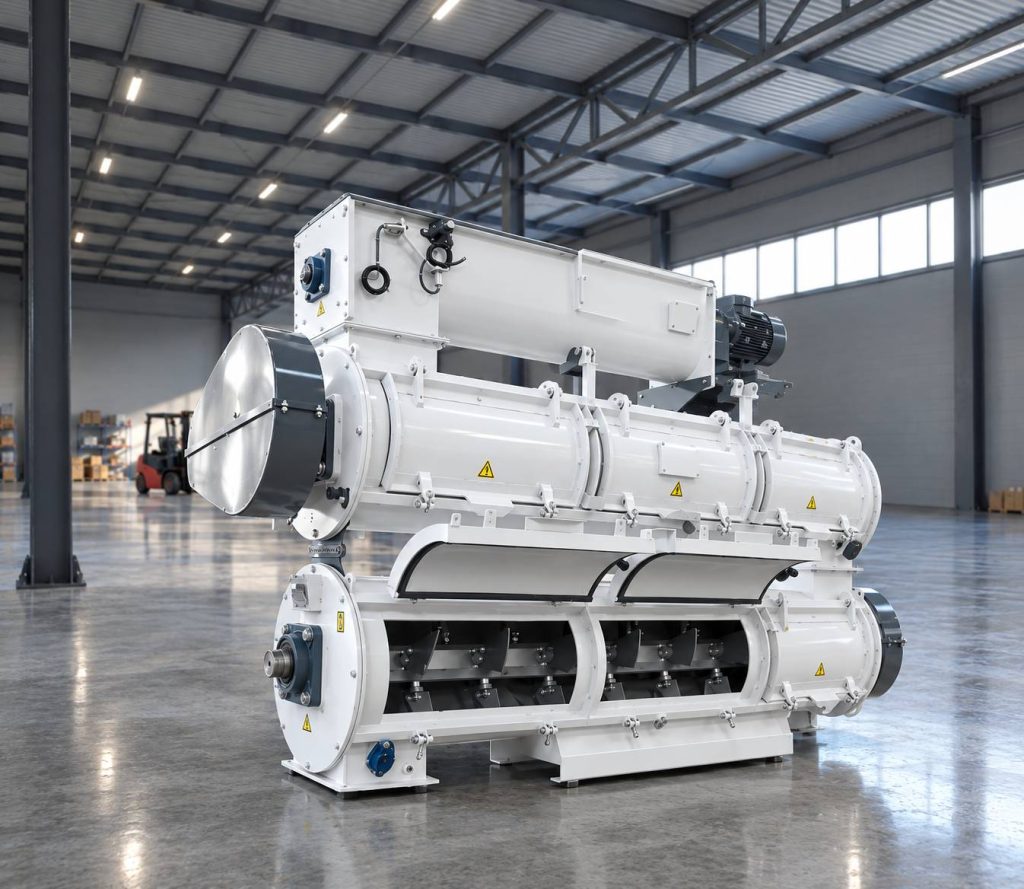
Conditioner Types in the Garama Electric Product Portfolio
We offer a variety of solutions tailored to your formulation type and production line sensitivity:
- Single Shaft Conditioners: A classic and reliable design for lines with standard production conditions.
- Twin Shaft Conditioners: For deeper mixing and more uniform heat and moisture distribution in complex formulations.
- High Retention Time (RT) Conditioners: Ideal for long-duration cooking and complete hygienic sterilization, particularly in poultry feed.
- Advanced Conditioning Systems (such as the Paladin series): Specialized thermal solutions for achieving the highest level of starch gelatinization and pellet quality.
Why Do Grama Electric Conditioners Excel in the Industry?
- Exceptional Hygiene and Biosecurity: Complete material cooking at controlled temperatures to fully eliminate bacteria and pathogens.
- Flexibility in Steam and Liquid Injection: Optimally designed paddles and nozzles ensure rapid and uniform penetration of steam and fat into the core of the particles.
- Increased Pellet Durability (PDI): Better material cooking means producing more robust pellets that do not crumble or become powder during transportation.
- Reduced Wear in the Subsequent Stage: The soft, homogeneous preparation of the material reduces the pressure and wear on the downstream pellet press or extruder.
Frequently Asked Questions about Grama Electric Industrial Conditioners
- What is the main role of the conditioner in the feed production line?
The conditioner’s function is to increase the moisture and temperature of the raw material through controlled steam injection before it enters the pellet press or extruder. This achieves three key objectives: partial starch gelatinization for better pellet binding, activation of binding agents, and complete sterilization to eliminate bacteria, especially Salmonella.
- What is the difference between a single shaft conditioner and a High Retention Time conditioner?
Standard conditioners provide a short retention time (a few seconds) for the material, which is sufficient for general feeds. However, in High Retention Time (RT) conditioners, the material remains in the thermal chamber for a much longer period (from several minutes to longer). These models are vital for factories requiring rigorous hygiene standards for poultry or aquaculture feed.
- Why does using a conditioner reduce waste (pellet powdering)?
One of the biggest problems in factories is pellets crumbling along the packaging and transportation route. Due to their adjustable paddle design and completely homogeneous cooking, conditioners create stronger molecular bonds between particles, which noticeably increases the Pellet Durability Index (PDI).
- Is the steam adjustment in conditioners performed automatically?
Yes; these conditioners are equipped with precise temperature and moisture control systems (such as thermocouples and automatic steam valves) so that the injected steam volume is adjusted in real time based on the incoming material flow rate, preventing over-wetting of the materials.