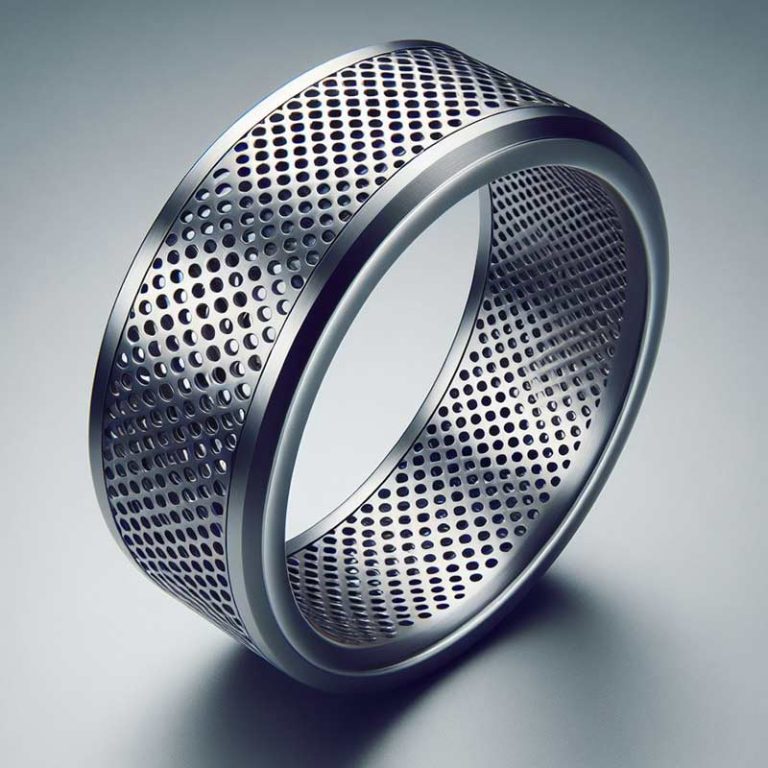




In the world of feed production, the die is the mold—and arguably the most important, most critical component in the entire pellet mill. If the rollers are the engine of production, the die is the production’s roadmap. All the technical specifications of the produced feed (size, hardness, fines content, and more) directly depend on the design and condition of the die.
Die Function
The die is a large, thick cylinder with a great number of holes bored into its surface.
- Process: Raw materials pass through the holes of the die. As they pass through, the rollers compress the material with great force.
- Output: The material exits from the end of the holes, taking the form of pellets (small cylinders). It is then cut to the desired length by a blade (the cutter discussed earlier).
Types of Dies by Structure (Important for Product Classification)
The main differences between dies used for poultry feed and those for aquaculture feed lie in the compression ratio, hole diameter, hole length, and sometimes the material of the die itself. These parameters directly affect pellet quality, water stability (for aquaculture), and digestibility.
- Flat Die: Typically used in smaller or semi-industrial machines. The mold is a flat plate with holes arranged across its surface.
- Ring Die: Used in large-scale industrial machines. The die takes the form of a large ring. This type of die is far more efficient for mass production because it has a greater contact surface with the rollers and distributes pressure evenly.
Let’s Examine the Differences:
1. Poultry Feed Die
- Primary Objective: Produce pellets that are easily consumed by poultry, generate less dust, and have a sufficiency gelatized starch content to enhance digestibility.
- Compression Ratio: Typically moderate. A compression ratio between 1:8 and 1:14 (hole length to hole diameter) is common for most poultry feeds. This ratio ensures the material is compressed enough to form a coherent pellet, but not so much that it consumes excess energy or damages the protein structure.
- Hole Diameter: Varies by the age and type of bird, but generally ranges from 2 mm to 6 mm, covering chick through laying hen and broiler feeds.
- Material and Hardness: Poultry dies are usually made of wear-resistant steels, but they do not require exceptional corrosion resistance. A suitable hardness to withstand the abrasion of common poultry feed ingredients (corn, soybean, wheat, etc.) is sufficient.
- Result: Relatively firm pellets, low dust content, and good digestibility.
2. Aquaculture Feed Die
Aquaculture feed involves greater complexity, since the pellet must not only be digestible but also maintain good water stability, and—depending on the fish or shrimp species—may need to float or sink.
- Primary Objective: Produce pellets that do not disintegrate in water, retain nutrients, and suit the target aquatic species (floating or sinking).
- Compression Ratio: Generally higher than that of poultry feed. A compression ratio between 1:12 and 1:24 or even higher is common. This higher compression contributes to better material densification and stronger starch gelatinization. Starch gelatinization is critical for pellet stability in water and for improved digestion in the aquatic animal’s digestive tract.
- Hole Length: To achieve a high compression ratio, the holes are typically longer.
- Hole Diameter: Similar to poultry, ranging from 1 mm to 6 mm, but for young fish or shrimp, much finer holes (e.g., 1–3 mm) are used.
- Material and Hardness:
- Wear Resistance: Still important, but the raw materials of aquaculture feed (such as fishmeal and algae extracts) can sometimes be more abrasive.
- Corrosion Resistance: This is a highly important factor. The aquatic environment and certain salts or compounds in aquaculture feed can cause die corrosion. Therefore, special alloy steels with higher corrosion resistance—or even specific coatings (such as chrome)—may be used.
- Special Note for Aquaculture Feed:
- Water Stability: High compression and proper starch gelatinization prevent the pellet from disintegrating in water, ensuring that nutrients are not leached away.
- Floating Feed: Producing floating feed requires additional processes beyond the die itself, such as utilizing lighter raw materials or employing an extrusion process. Standard pellet mill dies are not designed for this purpose; they are typically intended for sinking feeds or those with moderate water-residency requirements.
Operational Challenges
- Wear: Over time, the die holes enlarge due to the friction of the ingredients (particularly abrasive mineral components), which leads to a decline in pellet quality.
- Clogging: If the feed formulation or its fat content is improperly balanced, the die holes may become blocked.
- Temperature Distribution: The die heats up during operation; while this heat is necessary for pelletization (due to the “cooking” effect on the ingredients), excessive heat can damage the structural integrity of the nutrients.